Media Studies
Situated in the Royal College of Art School of Architecture and welcoming a student cohort from across multiple spatial design disciplines, Media Studies provides a rigorous and granular examination of historical and contemporary methodologies of media research and practice.
Our collective goal is to increase critical engagement with media.
We achieve this through lectures, tutorials, and workshops in which new approaches to media are conceptualised, refined, and implemented in innovative proposals and projects. Further, Media Studies is focused on non-representational media, stepping aside from traditional architectural media such as scaled drawings, models, and renderings, and instead applying our research to the creation of discrete media objects.
This unit is not interested in projective media that represents proposed buildings, environments, conditions, or situations. Robin Evans famously stated that “architects don’t build buildings, they make drawings”1. In other words, an architect’s practice is centred on the drawing or the representation of a building or space, not the actual building or space. Today, we could expand this observation to include contemporary representational media such as digital environments, static and dynamic analogue and digital renderings, or video and moving image, but Evans’ observation remains correct. Similarly, the media used to describe an academic project is not the building (or interior or city), it is a scaled representation, an abstracted approximation. In recent years the academic design studio has greatly expanded the range of media it deploys, but its representative nature remains.
Both the professional and the student assemble media to allow those fluent in this language to interpret these abstractions and conflate the various drawings, models, or images into a mental composited image of the final construction. All of this is a complex, discipline-specific media process based firmly in representation.
However, media can also be non-representational.
For example, a photograph can be interpreted as a non-representational, discreet media object; most photographs are not photographs of projected future photographs. One could argue that a contact sheet or the digital interface in Bridge or Lightroom are representations of a future photograph. But the actual photograph (whether it’s analogue or digital) is a unique object with its own embedded meaning whose context is dependent on the human or machine that made the image, the time in which it was produced, its cultural location, its political consequence, etc. The photograph just is. Similarly, a painting, a performance, a handmade book or an illustration is rarely – if ever – attempting to suggest the intention of another media type. While there are always exceptions to these rules, in Media Studies we will endeavour to make work that is non-representational.
What does this mean and why is it important?
Media Studies provides a space where media experimentation can take place outside of the design studio and its demands for representation. To do this we must first establish our own context and the range of work that we will engage. This is achieved by implementing the cumulative knowledge shared and discussed in our lectures and tutorials. It manifests in the projects that are created and finally tested by our collaboration with external professionals and academics. Media Studies will challenge you to create discreet media objects (video, books, sculpture, performance, text, photography, digital objects, exhibitions, situations, etc.) that are representative only of themselves, whose meaning resides in the media. We will research non-representational media and the artists, designers, architects, and theorists that make and write about such work. We will experiment with media for the sake of the media. We will create projects that sit between, outside, or in opposition to disciplines, focusing on media as a primary site and material of and for experimentation. We will investigate the emancipatory possibilities of media. We will acknowledge media’s complicity in processes of oppression, colonisation, and imperialism, and we will work to challenge and contest these realities.
Each year, we choose a conceptual scaffold to structure our research and projects. The theme this year is critical refusal.
2025/26 Course Description: Critical Refusal
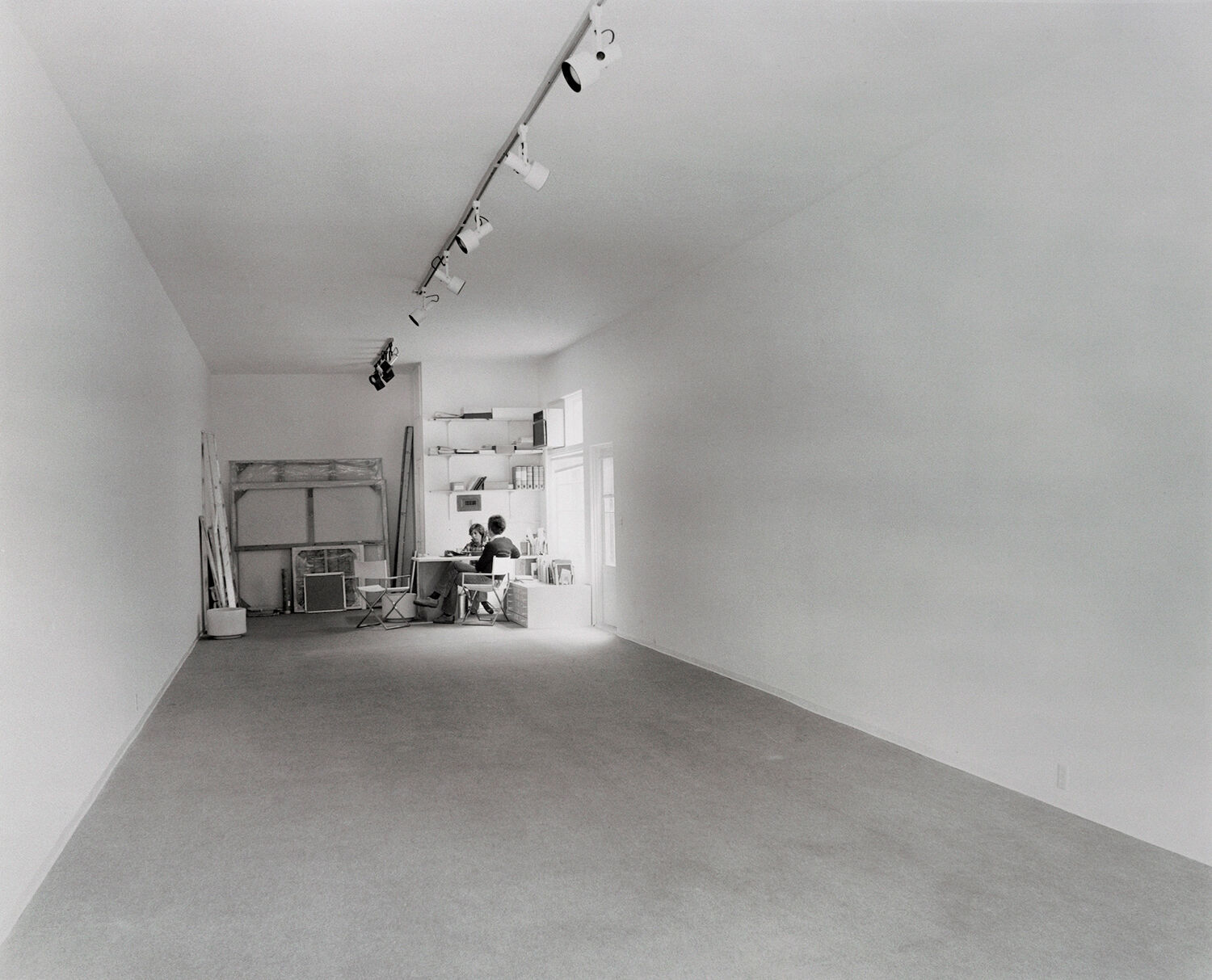
Michael Asher, "Claire Copley Gallery", 1974
In 1974, Los Angeles-based artist Michael Asher was invited by Claire Copley Gallery to create an installation. The gallery, originally a commercial storefront, was long and narrow with a glass storefront window and direct access from the street. The only interior architecture in the space was a partition wall separating the gallery space from a small administrative and storage area. Asher’s idea for his installation was simple; he proposed removing the partition wall and uniting the two spaces into a singular whole. The partition was disassembled and stored, the mounting hardware was removed, and the gap in the carpet on the floor was replaced. All water stains, cracks, and defects in the drywall were repaired. All markings or imperfections from previous installations were filled and sanded. Asher described these markings as “objects of perception”. In other words, the nail holes from prior object mounting, if left in the space, would detract from his intention of the making the space an “integrated and continuous flawless container”.2 Finally, the entire space was painted with standard white gallery paint.
The installation removed the barrier – physically and acoustically, and also conceptually – between the gallery space and the business space. Asher’s intention was to create a critical condition in which the viewers questioned the relationship between the experience of art and the capitalist commodification of art. Without the removal of the partition wall and the resulting conflict in the viewer, “a work of art could remain enclosed in its abstracted aesthetic context.”3 The abstraction he mentions is the disconnect achieved by the white walls of the gallery that blurs the reality that a commercial gallery’s primary function is to “transform the work’s aesthetic use-value into exchange-value.”4 By placing the artwork on the white walls of the gallery – separate from the business of art – the abstraction is reinforced. Asher’s removal of the partition wall disrupts this relationship, refusing to adhere to traditional relationships of art object and commerce.
This project exemplifies Asher’s decades-long research into what critics have described as institutional critique – Asher himself never used this descriptor. In other words, Asher’s art practice was not focused on the creation of objects and artefacts (paintings, sculpture, photographs, etc), instead he deployed staunchly site-specific work that served to critique a condition – whether physical or conceptual – of the spaces and institutions he was exhibiting within. The work often had little to no physical presence, instead Asher focused on alterations, minimal additions, or extractions from existing spaces. His medium was almost exclusively institutional architecture. He sculpted air, he researched and exposed archives, his collaborators were architects and engineers as often as curators and artists. Additionally, his work only existed for the span of the exhibition and was destroyed immediately following.
Asher’s work committed itself to the development of a practice of situational aesthetics that insisted on a critical refusal to provide an existing apparatus with legitimising aesthetic information, while at the same time revealing, if not changing, the existing conditions of the apparatus.5
This is exemplified in Asher’s exhibition at Heiner Friedrich Gallery in 1973. The installation involved painting the ceiling throughout the gallery and administrative spaces to mimic the colour and texture of the floors. When the gallery neglected to repaint the ceiling its original colour at the end of the exhibition – per Asher’s instructions – he sued the gallery, correctly claiming that by not repainting the ceiling constituted an unauthorised extension of the exhibition without the artist’s approval.
Artist Andrea Fraser, in her 2008 article for Art Forum titled “Procedural Matters: The Art of Michael Asher”, articulated Asher’s unique practice, saying:
While many artists making site-specific work have also created discrete objects, or packaged documentation, that circulate as commodities, Asher has consistently eschewed all commodity production and exchange. His is not a utopian rejection of economic exchange as such—a gesture which, in a capitalist society, can only be symbolic—but a very practical and specific substitution of one economy for another.6
Perhaps it's antithetical to craft a project-based arts unit around the concept of refusal. It stands in contradiction to the hyper-commercialisation of “content”, where even the most basic conversations and observations need corporate sponsorship and endorsement. But maybe Michael Asher’s steadfast commitment to refuse can give us fresh approach to concept of creation. His work can free us of the nagging persistence that everything we make requires something in return. This year, our tenth, Media Studies will look past the obvious, the spectacular, and the popular, in a sincere attempt to quiet the noise and understand the systems and infrastructures that seek to control.
Or as Pailhead sang in 1987, “I will refuse.”
David Burns, Media Studies Lead
Evans, R. (1996) "Translations from Drawing to Building and Other Essays". London: Architectural Association Publications. ↩
Asher, M. Writings 1973–1983 on Works 1969–1979, Primary Information (2021), p.95. ↩
Ibid. ↩
Ibid. ↩
Buchloh, B. Writings 1973–1983 on Works 1969–1979, Primary Information (2021), p.p. VII. ↩
Fraser, A. (2008) Procedural Matters: The Art of Michael Asher, Art Forum, Summer 2008 Vol. 46, No. 10. ↩